
Partner Spotlight: Alameda County Community Food Bank
In Conversation with Regi Young, Executive Director
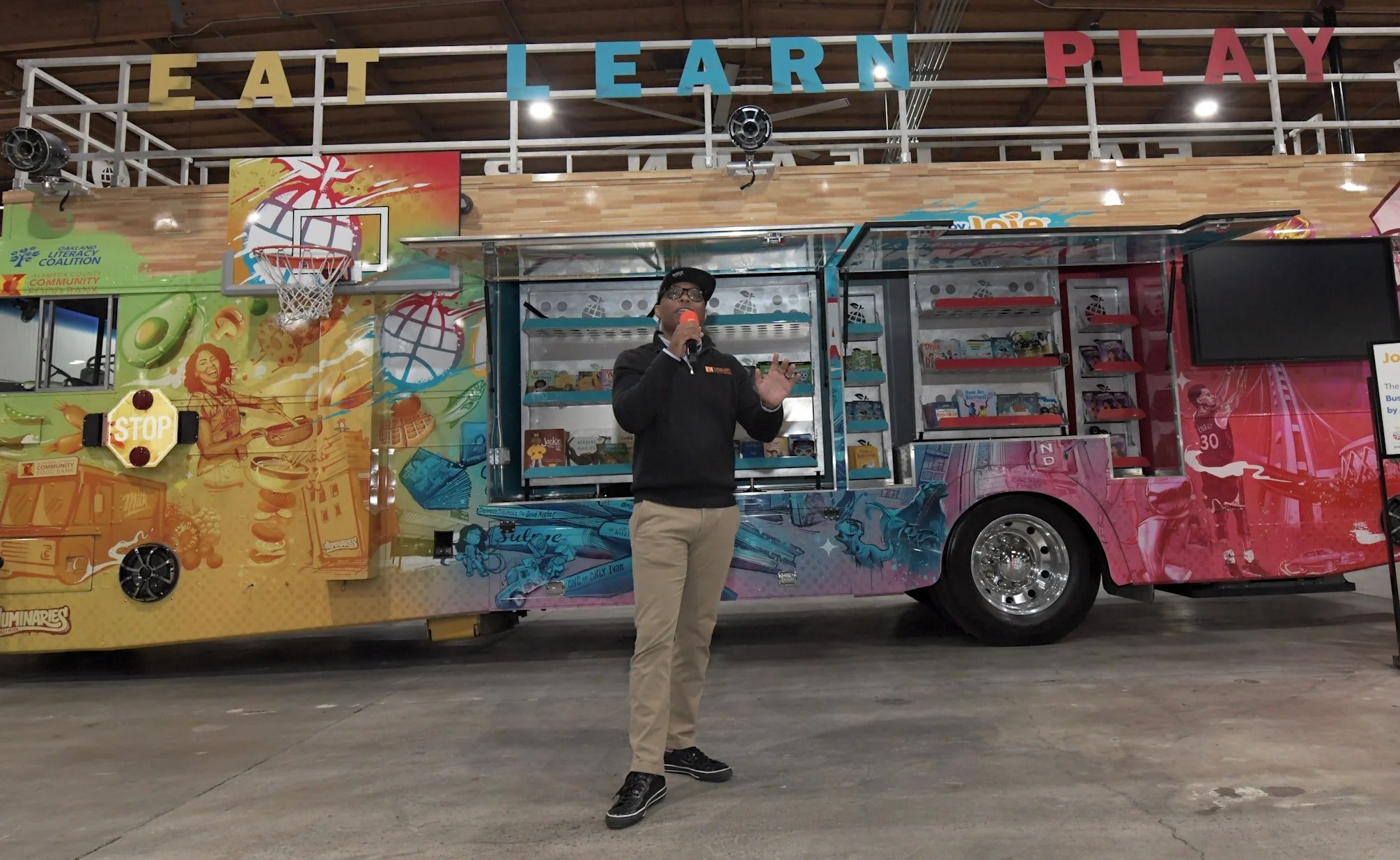
Regi Young, Executive Director of Alameda County Community Food Bank
Access to healthy food for kids is a key pillar of our work at Eat. Learn. Play., laying the foundation for academic success and well-being. In Oakland, 1 in 4 children lives with food insecurity, and more than 80 percent of students qualify for free or reduced-price meals. Our partnership with Alameda County Community Food Bank (ACCFB) helps us meet families where they are, with dignity, with consistency, and with the kind of fresh, nutritious food every kid deserves. We spoke with Regi Young, Executive Director of ACCFB, about the impact of our work over seven years of partnership.
Together, ACCFB and Eat. Learn. Play. have distributed 15 million meals into the community since our founding. What is the impact you have seen on Oakland kids?
Every single one of those millions of meals is a chance for an Oakland kid to get food in a convenient, positive, and dignified way. The smiles on kids faces are the strongest measure of the positive impact Eat. Learn. Play. has.
One of the strengths of our partnership is the ability to work together to quickly respond to community needs. How have you seen this come to life?
Nowhere was this more clear than at the start of the COVID-19 pandemic. Right before schools closed, when Eat. Learn. Play. reached out to ACCFB to act swiftly to make sure that when schools closed their doors, that students wouldn’t lose access to the food they need. Not only did we act quickly, we leveled up our relationship, working hip-to-hip from that day forward to respond to the emergency at hand while creating meaningful programming for local kids.
Last summer, when budget constraints threatened the program that provides summer meals for Oakland kids, Eat. Learn. Play. and ACCFB knew just what to do, teaming up to partner with the City of Oakland and East Bay Community Foundation to ensure that this essential program would continue to give kids the meals they rely on. This is all thanks to the infrastructure and partnerships we’ve built together.
Can you share a favorite memory of Eat. Learn. Play. and ACCFB from the past 7 years of working together?
My favorite memory of Eat. Learn. Play. was on my second day at ACCFB when we debuted the bus at East Oakland Youth Development Center. The youth present saw the bus and immediately ran towards it, excited. However, they didn’t realize at first that Steph and Ayesha were on the bus. That surprise brought so much joy to the students and everyone else in attendance.
For me, that experience was one of the rare times I’ve seen people literally running with excitement to a food distribution, and it set the tone for the type of experiences that would continue to be co-designed by Eat. Learn. Play., ACCFB, and others.
The Eat. Learn. Play. Bus and Mobile Pantries (MOPA) give us the ability to reach many communities in a fun and festive way. Why is joy such an important part of this process?
The experience at the East Oakland Youth Development Center, and at every other Eat. Learn. Play. event I’ve been to since can only be described as joyful. Designing for joyful experiences is a primary focus of our partnership, and it is critical that children and their families feel both joy and dignity in their interactions with us, as many of them are facing significant challenges in other aspects of their lives.
Volunteerism is central to both Eat. Learn. Play. and ACCFB’s ability to accelerate our impact in the community. What is your call to action for folks who want to get more involved in our work?
Volunteers are essential to the work we do. Whether you’re packing produce in our warehouse, helping with a community event, or working with one of our partners (such as Eat. Learn. Play.), there are many ways to get involved, to deepen your connections to our shared community, and to have fun while you do it. I encourage you to get involved in a way that works for you by volunteering, donating, advocating for anti-hunger policy, or joining our community organizing efforts.
What is your hope for what’s to come?
Hope is an essential piece of our work towards food justice. I have hope that we can partner with the community to end hunger and its root causes. My hope is fueled by the interactions I have with members of the community who are joining us on this journey towards justice. I find hope in the ideas people share, in how we navigate challenges together, and in the ways we take care of each other. I find hope in our partnership with Eat. Learn. Play.—in the joy and support that kids find—and in the ways it helps ensure that all of us are nourished and thriving.